NDVI threshold for cover crop establishment, explained
What the index is measuring
NDVI is a ratio built from how much red light a plant's canopy absorbs versus how much near-infrared light it bounces back. Bare soil, dead residue, and a thin stand of cereal rye don't reflect the same way, and that reflectance gap is what lets a pass sort a field into "established" or not.
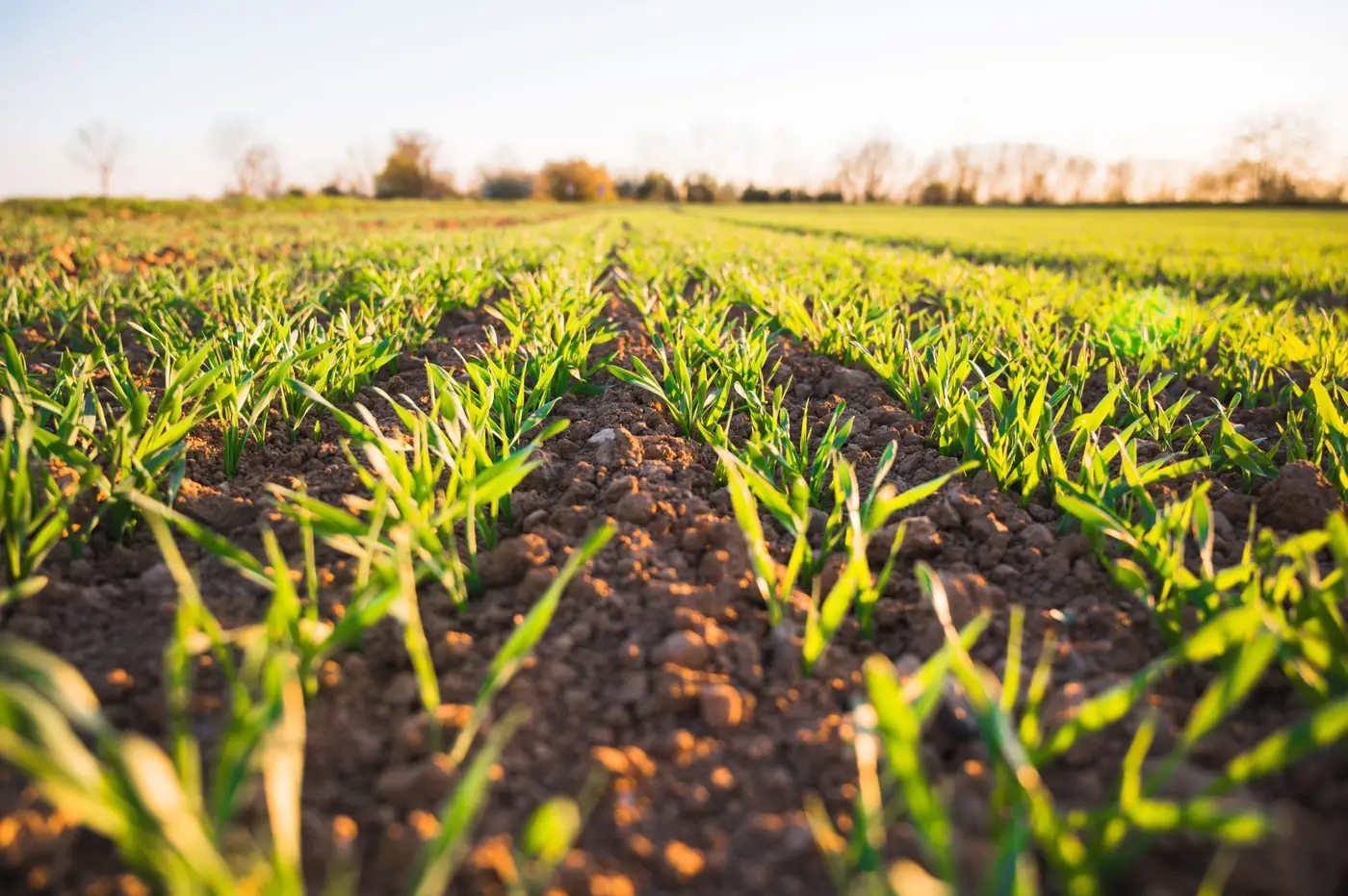
A pixel over healthy green growth comes back with a high NDVI value, typically somewhere above 0.3 once a stand has real leaf area out. A pixel over bare dirt, crop stubble, or a cover crop that barely emerged sits much lower, often under 0.2. The green-up signal is the jump between those two states as a field moves from planted-but-not-up to covering ground.
Why one number doesn't work everywhere
The problem for anyone trying to verify practice claims at scale is that the vegetation index cutoff separating "established" from "not yet" shifts with crop type, seed date, soil background, and even sun angle on the day of the pass. A thick stand of crimson clover and a sparse stand of oats can both be real cover crops and still produce different NDVI curves two weeks after planting. A cutoff tuned for one region's soil color can misclassify a field two counties over.
That's why serious establishment classification doesn't lean on a single hard number pulled from a paper. It treats the index as one input, reads the trend across a few passes in a season instead of one snapshot, and checks the field against what else shows up in the same pass, residue pattern and row geometry included, before calling a field established, thin, or bare.
How this plays into program verification
For a soil-carbon program or a brand sustainability team, the practical question isn't "what's the exact threshold." It's whether the field a grower reported as cover-cropped actually shows green-up on the timeline the practice claim describes, and whether that green-up holds or fades before the season's out. A field that greens up and then drops back to bare-soil reflectance a month later tells a different story than one that holds a steady signal through the program's establishment window.
This is also where self-reported acreage and remote classification tend to diverge. A grower may have planted a mix that's agronomically real but patchy, or drilled late into a dry seedbed, and the index will show that honestly even when the enrollment paperwork says the field is in. None of that replaces a field visit. It means a verifier isn't starting from zero on every enrolled acre when a wide-swath pass can already flag which fields are worth a second look.
If you're the one signing off on a season's worth of practice claims across a few hundred enrolled fields, Cover Crop Check is built for that step: season-by-season confirmation of cover-crop establishment and residue cover from multispectral passes over the field boundaries you've already drawn, so payment tracks what the field shows rather than what the form says.
A few things worth knowing before you lean on this
- The signal is strongest once a stand has meaningful canopy. Very early-season passes will undercount real plantings that just haven't grown yet.
- Residue cover reads differently than green cover. A field can show high crop residue and still classify as "not established" if the cover species hasn't emerged.
- Cloud cover, standing water, and recent tillage all distort a single pass. That's the argument for tracking a field across the program period instead of judging it off one date.
None of this replaces knowing your own program's planting windows and species mix. But understanding what the index is doing under the hood, instead of treating "NDVI threshold" as one fixed magic number, is most of what you need to read an establishment classification correctly.
If you want a walk-through of how this reads on your own enrolled fields this season, that's what Cover Crop Check is built for.